



Best Business Podcast (Gold), British Podcast Awards 2023 How do you build a fully electric motorcycle with no compromises on performance? How can we truly experience what the virtual world feels like? What does it take to design the first commercially available flying car? And how do you build a lightsaber? These are some of the questions this podcast answers as we share the moments where digital transforms physical, and meet the brilliant minds behind some of the most innovative products a ...
…
continue reading

Content provided by O'Reilly Media. All podcast content including episodes, graphics, and podcast descriptions are uploaded and provided directly by O'Reilly Media or their podcast platform partner. If you believe someone is using your copyrighted work without your permission, you can follow the process outlined here https://podcastplayer.com/legal.
Similar to O'Reilly Data Show Podcast
Custom Manufacturing Industry podcast is an entrepreneurship and motivational podcast on all platforms, hosted by Aaron Clippinger. Being CEO of multiple companies including the signage industry and the software industry, Aaron has over 20 years of consulting and business management. His software has grown internationally and with over a billion dollars annually going through the software. Using his Accounting degree, Aaron will be talking about his organizational ways to get things done. Hi ...
…
continue reading
It didn’t all change in March 2020. Not really. The UK high street has been in the throes of a gradual revolution for decades. From the rise of ecommerce, to the birth of mobile, social commerce, and a growing emphasis on experience, change has been underway for a while. In fact for many, the pandemic has acted as a wake-up call. Digital transformation was no longer a ‘nice to have’ but a matter of survival. Necessity sparked innovation and customers are enjoying more flexibility and conveni ...
…
continue reading
Tim Reid (AKA Timbo) interviews the most innovative founders in the world of small business. In this award winning podcast business owners share where their original business idea came from, how they got it to market and the strategies they used that led to their business’s unprecedented growth. Tim Reid's curiosity for what makes business owners tick and his passion for small business success means that every episode is chock full of marketing gold that will help you build that beautiful bu ...
…
continue reading
The Knowledge at Wharton Network Acast feed serves as a curated showcase highlighting the best content from our podcast collection. Each week, we feature one standout episode from each show in the Wharton Podcast Network, giving listeners a comprehensive sample of our diverse business and academic content. This rotating selection allows audiences to discover new shows within our network while experiencing the depth and variety of Wharton's thought leadership across different topics and forma ...
…
continue reading
Decoder is a show from The Verge about big ideas — and other problems. Verge editor-in-chief Nilay Patel talks to a diverse cast of innovators and policymakers at the frontiers of business and technology to reveal how they’re navigating an ever-changing landscape, what keeps them up at night, and what it all means for our shared future.
…
continue reading
Alessandro Bogliari, CEO and Co-Founder of The Influencer Marketing Factory, a global influencer marketing agency, talks with great guests about influencer marketing, social media, the creator economy, social commerce and much more.
…
continue reading
Bitcoin groundbreakers share personal stories of how Bitcoin is changing lives for the better. Host Mauricio Di Bartolomeo, co-founder and CSO of Ledn, speaks with leading Bitcoin voices, entrepreneurs, and human rights advocates to hear their unique journey and practical real-world examples of how Bitcoin has made a positive impact in their lives. Brought to you by Ledn, a leading financial services company built for Bitcoin & digital assets. Ledn offers a suite of lending, saving and tradi ...
…
continue reading
Pat Flynn from The Smart Passive Income Blog reveals all of his online business and blogging strategies, income sources and killer marketing tips and tricks so you can be ahead of the curve with your online business or blog. Discover how you can create multiple passive income streams that work for you so that you can have the time and freedom to do what you love, whether it's traveling the world, or just living comfortably at home. Since 2008, he's been supporting his family with his many on ...
…
continue reading
Where startup founders raise millions and listeners can invest. Host Josh Muccio takes listeners behind closed-doors and into the room where deals are made. Part of the Vox Media Podcast Network.
…
continue reading

Player FM - Podcast App
Go offline with the Player FM app!
Go offline with the Player FM app!

))

Labeling, transforming, and structuring training data sets for machine learning


Manage episode 248276917 series 1652310
Content provided by O'Reilly Media. All podcast content including episodes, graphics, and podcast descriptions are uploaded and provided directly by O'Reilly Media or their podcast platform partner. If you believe someone is using your copyrighted work without your permission, you can follow the process outlined here https://podcastplayer.com/legal.
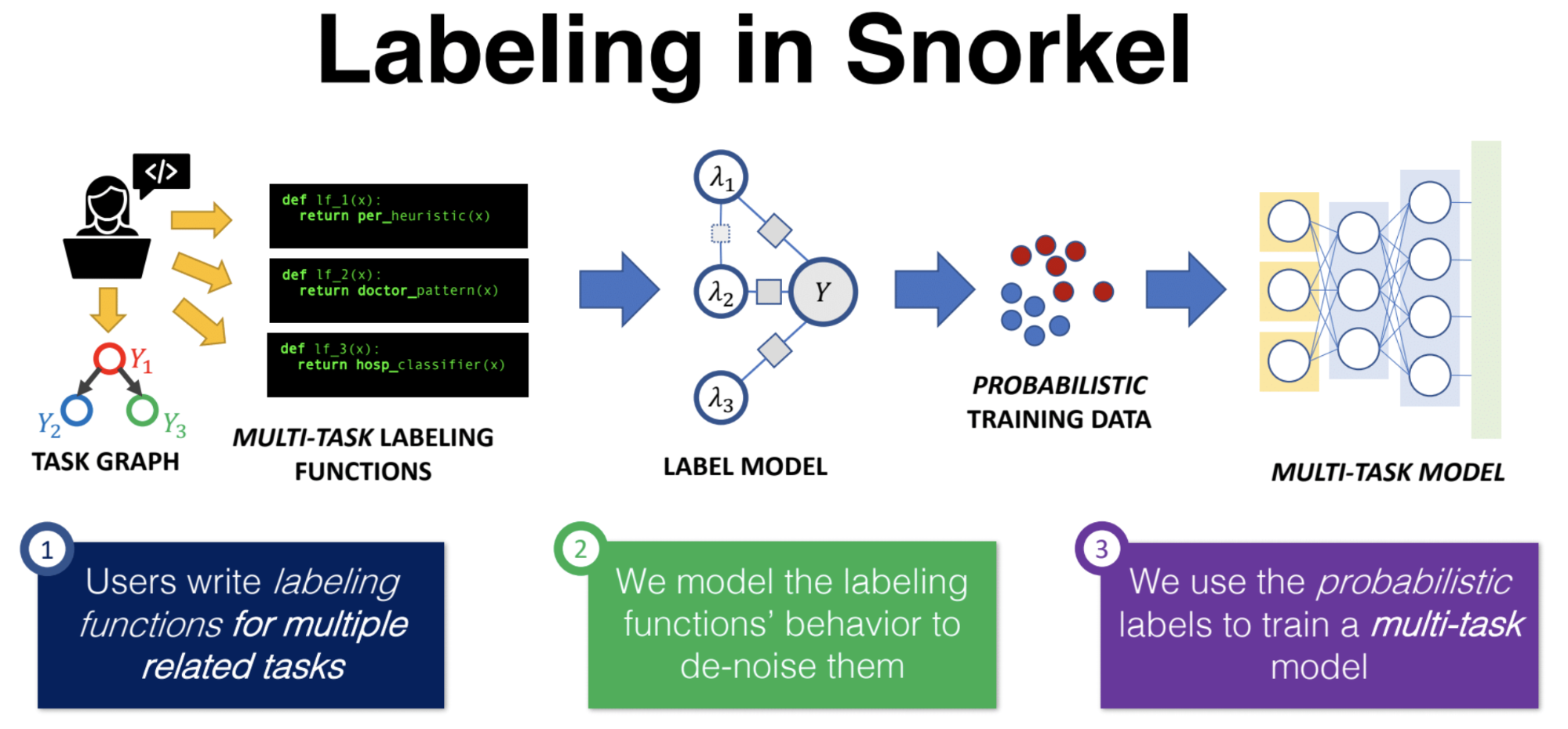
In this episode of the Data Show, I speak with Alex Ratner, project lead for Stanford’s Snorkel open source project; Ratner also recently garnered a faculty position at the University of Washington and is currently working on a company supporting and extending the Snorkel project. Snorkel is a framework for building and managing training data. Based on our survey from earlier this year, labeled data remains a key bottleneck for organizations building machine learning applications and services.
Ratner was a guest on the podcast a little over two years ago when Snorkel was a relatively new project. Since then, Snorkel has added more features, expanded into computer vision use cases, and now boasts many users, including Google, Intel, IBM, and other organizations. Along with his thesis advisor professor Chris Ré of Stanford, Ratner and his collaborators have long championed the importance of building tools aimed squarely at helping teams build and manage training data. With today’s release of Snorkel version 0.9, we are a step closer to having a framework that enables the programmatic creation of training data sets.
We had a great conversation spanning many topics, including:
- Why he and his collaborators decided to focus on “data programming” and tools for building and managing training data.
- A tour through Snorkel, including its target users and key components.
- What’s in the newly released version (v 0.9) of Snorkel.
- The number of Snorkel’s users has grown quite a bit since we last spoke, so we went through some of the common use cases for the project.
- Data lineage, AutoML, and end-to-end automation of machine learning pipelines.
- Holoclean and other projects focused on data quality and data programming.
- The need for tools that can ease the transition from raw data to derived data (e.g., entities), insights, and even knowledge.
Related resources:
- “Product management in the machine learning era”: A tutorial at the Artificial Intelligence Conference in San Jose, September 9-12, 2019.
- Chris Ré: “Software 2.0 and Snorkel”
- Alex Ratner: “Creating large training data sets quickly”
- Ihab Ilyas and Ben Lorica on “The quest for high-quality data”
- Roger Chen: “Acquiring and sharing high-quality data”
- Jeff Jonas on “Real-time entity resolution made accessible”
- “Data collection and data markets in the age of privacy and machine learning”
133 episodes
 Share
Share


Manage episode 248276917 series 1652310
Content provided by O'Reilly Media. All podcast content including episodes, graphics, and podcast descriptions are uploaded and provided directly by O'Reilly Media or their podcast platform partner. If you believe someone is using your copyrighted work without your permission, you can follow the process outlined here https://podcastplayer.com/legal.
In this episode of the Data Show, I speak with Alex Ratner, project lead for Stanford’s Snorkel open source project; Ratner also recently garnered a faculty position at the University of Washington and is currently working on a company supporting and extending the Snorkel project. Snorkel is a framework for building and managing training data. Based on our survey from earlier this year, labeled data remains a key bottleneck for organizations building machine learning applications and services.
Ratner was a guest on the podcast a little over two years ago when Snorkel was a relatively new project. Since then, Snorkel has added more features, expanded into computer vision use cases, and now boasts many users, including Google, Intel, IBM, and other organizations. Along with his thesis advisor professor Chris Ré of Stanford, Ratner and his collaborators have long championed the importance of building tools aimed squarely at helping teams build and manage training data. With today’s release of Snorkel version 0.9, we are a step closer to having a framework that enables the programmatic creation of training data sets.
We had a great conversation spanning many topics, including:
- Why he and his collaborators decided to focus on “data programming” and tools for building and managing training data.
- A tour through Snorkel, including its target users and key components.
- What’s in the newly released version (v 0.9) of Snorkel.
- The number of Snorkel’s users has grown quite a bit since we last spoke, so we went through some of the common use cases for the project.
- Data lineage, AutoML, and end-to-end automation of machine learning pipelines.
- Holoclean and other projects focused on data quality and data programming.
- The need for tools that can ease the transition from raw data to derived data (e.g., entities), insights, and even knowledge.
Related resources:
- “Product management in the machine learning era”: A tutorial at the Artificial Intelligence Conference in San Jose, September 9-12, 2019.
- Chris Ré: “Software 2.0 and Snorkel”
- Alex Ratner: “Creating large training data sets quickly”
- Ihab Ilyas and Ben Lorica on “The quest for high-quality data”
- Roger Chen: “Acquiring and sharing high-quality data”
- Jeff Jonas on “Real-time entity resolution made accessible”
- “Data collection and data markets in the age of privacy and machine learning”
133 episodes
All episodes
×
Welcome to Player FM!
Player FM is scanning the web for high-quality podcasts for you to enjoy right now. It's the best podcast app and works on Android, iPhone, and the web. Signup to sync subscriptions across devices.
Similar to O'Reilly Data Show Podcast
Best Business Podcast (Gold), British Podcast Awards 2023 How do you build a fully electric motorcycle with no compromises on performance? How can we truly experience what the virtual world feels like? What does it take to design the first commercially available flying car? And how do you build a lightsaber? These are some of the questions this podcast answers as we share the moments where digital transforms physical, and meet the brilliant minds behind some of the most innovative products a ...
…
continue reading
Custom Manufacturing Industry podcast is an entrepreneurship and motivational podcast on all platforms, hosted by Aaron Clippinger. Being CEO of multiple companies including the signage industry and the software industry, Aaron has over 20 years of consulting and business management. His software has grown internationally and with over a billion dollars annually going through the software. Using his Accounting degree, Aaron will be talking about his organizational ways to get things done. Hi ...
…
continue reading
It didn’t all change in March 2020. Not really. The UK high street has been in the throes of a gradual revolution for decades. From the rise of ecommerce, to the birth of mobile, social commerce, and a growing emphasis on experience, change has been underway for a while. In fact for many, the pandemic has acted as a wake-up call. Digital transformation was no longer a ‘nice to have’ but a matter of survival. Necessity sparked innovation and customers are enjoying more flexibility and conveni ...
…
continue reading
Tim Reid (AKA Timbo) interviews the most innovative founders in the world of small business. In this award winning podcast business owners share where their original business idea came from, how they got it to market and the strategies they used that led to their business’s unprecedented growth. Tim Reid's curiosity for what makes business owners tick and his passion for small business success means that every episode is chock full of marketing gold that will help you build that beautiful bu ...
…
continue reading
The Knowledge at Wharton Network Acast feed serves as a curated showcase highlighting the best content from our podcast collection. Each week, we feature one standout episode from each show in the Wharton Podcast Network, giving listeners a comprehensive sample of our diverse business and academic content. This rotating selection allows audiences to discover new shows within our network while experiencing the depth and variety of Wharton's thought leadership across different topics and forma ...
…
continue reading
Decoder is a show from The Verge about big ideas — and other problems. Verge editor-in-chief Nilay Patel talks to a diverse cast of innovators and policymakers at the frontiers of business and technology to reveal how they’re navigating an ever-changing landscape, what keeps them up at night, and what it all means for our shared future.
…
continue reading
Alessandro Bogliari, CEO and Co-Founder of The Influencer Marketing Factory, a global influencer marketing agency, talks with great guests about influencer marketing, social media, the creator economy, social commerce and much more.
…
continue reading
Bitcoin groundbreakers share personal stories of how Bitcoin is changing lives for the better. Host Mauricio Di Bartolomeo, co-founder and CSO of Ledn, speaks with leading Bitcoin voices, entrepreneurs, and human rights advocates to hear their unique journey and practical real-world examples of how Bitcoin has made a positive impact in their lives. Brought to you by Ledn, a leading financial services company built for Bitcoin & digital assets. Ledn offers a suite of lending, saving and tradi ...
…
continue reading
Pat Flynn from The Smart Passive Income Blog reveals all of his online business and blogging strategies, income sources and killer marketing tips and tricks so you can be ahead of the curve with your online business or blog. Discover how you can create multiple passive income streams that work for you so that you can have the time and freedom to do what you love, whether it's traveling the world, or just living comfortably at home. Since 2008, he's been supporting his family with his many on ...
…
continue reading
Where startup founders raise millions and listeners can invest. Host Josh Muccio takes listeners behind closed-doors and into the room where deals are made. Part of the Vox Media Podcast Network.
…
continue reading
Player FM - Podcast App
Go offline with the Player FM app!
Go offline with the Player FM app!


